A Rural Health Roadmap Series Blog Entry
Author: Will Williams
Date: March 26, 2026
Most healthcare practices focus on seeing more patients for fee-for-service revenue. For Rural Health Clinics (RHCs), cost-based reimbursement makes payer mix more critical than patient volume.
Specifically, the traditional (Straight) Medicare percentage is your operation’s financial anchor. Though MA and commercial plans look similar, year-end cost reports show their differences.
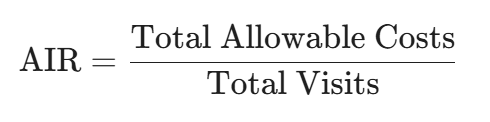
Payer mix matters because RHCs use the AIR calculation. Unlike standard clinics, an independent RHC is reimbursed based on its actual allowable costs rather than CPT schedules.
The formula is uncomplicated: Total Allowable Expenses ÷ Total Number of Patient Visits = All-Inclusive Rate (AIR)
Maximizing your reimbursement requires your cost-per-visit to meet or exceed the $165.00 cap. Under-reporting allowable costs—such as EHR technology, medical supplies, and non-provider clinical staff time—artificially lowers your AIR.

The Interim Rate vs. The Settled Rate
The AIR serves as your annual reimbursement floor.
1. Interim Payments: Medicare pays an interim rate per visit throughout the year, typically between $110 and $130.
2. The Settlement: At year-end, you file a cost report. If your cost per visit is $160, but Medicare paid $120 all year, Medicare pays you the difference for each Traditional Medicare visit.
Payer mix is critical because only Traditional Medicare has this settlement. If your costs exceed payments, only your Medicare visits are protected.
Imagine your clinic is a ship at sea. The "Allowable Expenses" (staffing, rent, supplies) are the weight of the ship. The "Patient Visits" are the distance you travel.
If 70% of your patients are Traditional Medicare, 70% of your clinic's costs are "anchored" to your actual expenses. If only 20% are Traditional Medicare, 80% of your costs are drifting, leaving you vulnerable to RHC underpayment issues.
Many RHC owners believe MA plans follow Traditional Medicare rules. They do not.
The NARHC 2025 Policy Survey found over half of RHCs get lower reimbursement from MA plans, which pay agreed—not settled—rates.
If your AIR is $155 and MA pays $125, you lose $30 per visit—$30,000 over 1,000 visits, with no year-end settlements for MA or commercial plans.
RHC strategies must focus on Traditional Medicare or use cost-report data to demand better MA rates.
Learn more about how Oasis Medical Solutions and Azalea Health provide a stable, all-in-one solution for Rural Health Clinics, or contact us today for a consultation.
One of the most overlooked revenue streams in an RHC is Medicare Bad Debt reimbursement. RHCs can recover 65% of uncollectible Traditional Medicare deductibles and coinsurance under 42 CFR 413.89.
To claim this, a practice must follow a strict four-step process:
Commercial and MA plans don’t cover bad debt, so a non-Medicare payer mix forfeits this 65% recovery.
Operational Insight: While this guide covers best practices for Traditional Medicare Payer Mix, consistent revenue depends on daily workflow. For a deep dive into day-to-day optimization, read our [8 Best Practices for a Healthier RHC Revenue Cycle]
To maximize payer mix, master Form CMS-222-17, the required document for settling independent RHC rates.
For clinics with less than $50,000 in total Medicare reimbursement, the choice between "Low Utilization" and "Full Reporting" is a strategic decision. While Low Utilization is simpler, it often masks the true cost of care and leaves revenue on the table.
| Feature | Low Utilization Report | Full Cost Report (CMS-222-17) |
|---|---|---|
| Filing Requirement | Meets minimum CMS compliance. | Meets compliance and provides depth. |
| Cost Allocation | Limited financial disclosure. | Complete Trial Balance of Expenses. |
| Medicare Bad Debt | Ineligible for reimbursement. | Eligible for 65% recovery. |
| AIR Integrity | Does not support rate re-evaluation. | Provides data for rate defense/audits. |
| Productivity Data | Not required/reported. | Full visit and FTE documentation. |
| Strategic Value | Minimal; purely administrative. | High; used for contract negotiations. |
To ensure your RHC cost reporting support is effective, your billing and management teams must understand the "engine" of the report. Here is a breakdown of the critical worksheet
Historically, CMS applied "productivity standards" (e.g., requiring a physician to see 4,200 patients per year) to determine the AIR. If you didn't hit that volume, your rate was artificially lowered.
Significant Update: For reporting periods after Dec 31, 2024, productivity standards end. Actual costs become the primary rate driver, so accuracy in Worksheet A matters more than ever.
Compare two clinics with identical $300,000 operating costs and 2,000 visits ($150 per visit).
Clinic B recouped $28,000 more in expenses for the same work.
Related Resources:
• CMS RHC Program Fact Sheet
• Electronic Code of Federal Regulations (Bad Debt)
• CMS Publication 100-04 (Claims Processing Manual Chapter 9)
• NARHC Policy News
• CMS Form 222-17 Official Instructions
• View our Full RHC Reimbursement Guide here.
• Form CMS-222-17: An overview of the Independent RHC Cost Report
• RHC Best Practices for a Healthier Revenue Cycle.
• Oasis supports Rural Health Clinics: Learn more about solving the core challenges of your RHC.
With a new understanding of how the mix works, how can rural health clinics optimize their payer mix to improve revenue?
Managing these complex financial ratios requires more than just a billing person; it requires an integrated IT and RCM ecosystem.
As a specialized value-added reseller (VAR), Oasis Medical Solutions provides healthcare IT support to rural health clinics, helping them gain insight into these metrics. Our systems are designed to:
• Automate the splitting of G-codes and CPT codes for RHC compliance.
• Deliver analytics to track payer mix and "Solve for X" projections.
• Offer RHC cost reporting support to ensure your Worksheet A is audit-ready.
Oasis supplies a comprehensive management solution for your RHC, whether you are establishing a new RHC Startup clinic, updating processes and software, or strengthening practice revenue.
1. Evaluate current landscape
2. Identify inadequacies
3. Define what "success" looks like
4. Build a comprehensive, clinic-focused plan to address inadequacies and reach success.
5. Consultation and navigation to execute the plan and bring "success" to fruition
6. Conveying "success" on form Form CMS-222-17 to achieve maximum-allowable, settled AIR.
7. Negotiating for your best settled AIR
8. Building on success into the future via expansion and/or broadening service offerings.
The RHC model was designed to ensure that rural providers don't go out of business while serving their communities. Through understanding the importance of your Traditional Medicare payer mix, you move from reactive billing to active financial stewardship.
This is a critical time for RHC leaders to be proactive. We recommend contacting your state's Department of Health or Rural Health Office to learn about the specific initiatives they have proposed and how your clinic can be involved in allocating these funds.
No. This is one of the most common misconceptions in Medicare billing for RHCs. Medicare Advantage (MA) plans are private insurers that pay based on a negotiated fee schedule. They do not participate in the annual cost report settlement process. If your MA contract pays $120 but your actual cost per visit is $160, you cannot recover that $40 difference through the cost report.
For the 2026 calendar year, the national statutory payment limit (the cap) for independent RHCs is $165 per visit. If your traditional Medicare payer mix is high, you can recover costs up to this $165 limit. If your negotiated commercial or MA rates are significantly below this $165 cap, your clinic is losing potential revenue on every non-Medicare visit.
Filing a full cost report is a matter of long-term financial stewardship. A low utilization report does not document your full cost structure or visit data. By filing a full report, you build an audit-defensible history of your actual operating costs, which is essential for defending your AIR and claiming RHC bad debt reimbursement.
For cost reporting periods ending after December 31, 2024, CMS has sunsetted the mandatory productivity standards for cost reporting. This means your reimbursement will be based on your actual allowable costs rather than being penalized if your providers didn't meet specific volume "quotas." This allows for more flexible staffing models, such as utilizing more Nurse Practitioners or Physician Assistants without fear of a rate penalty.
es. Through the Medicare Bad Debt provision, RHCs can recover 65% of uncollectible deductibles and coinsurance for Traditional Medicare patients. To claim this, you must document a "reasonable collection effort" (typically 120 days) and report these losses on your full annual cost report.
"Solving for X" is a strategic math exercise in which you work backward from the $165 cap to determine your ideal patient volume. By totaling your fixed expenses and desired salaries (the numerator) and dividing by $165 (the rate), you determine exactly how many visits (the denominator) you need to achieve maximum reimbursement efficiency.
Oasis Medical Solutions is a trusted partner for healthcare practices, offering comprehensive services and support for Azalea Health's suite of electronic health record (EHR) and practice management solutions. Focusing on personalized implementation, training, and ongoing support, Oasis Medical Solutions helps clients optimize their technology to improve efficiency and deliver exceptional patient care.
Oasis Medical Solutions is a healthcare technology company that helps medical practices streamline their operations and maximize revenue. We specialize in providing Electronic Health Records (EHR) systems and related services, including practice management software, billing solutions, and consulting.
With a focus on personalized service and customized solutions, Oasis aims to empower healthcare providers to navigate the complexities of the healthcare industry and focus on delivering quality patient care.
Schedule a free consultation or explore more about Oasis